
The Privateers
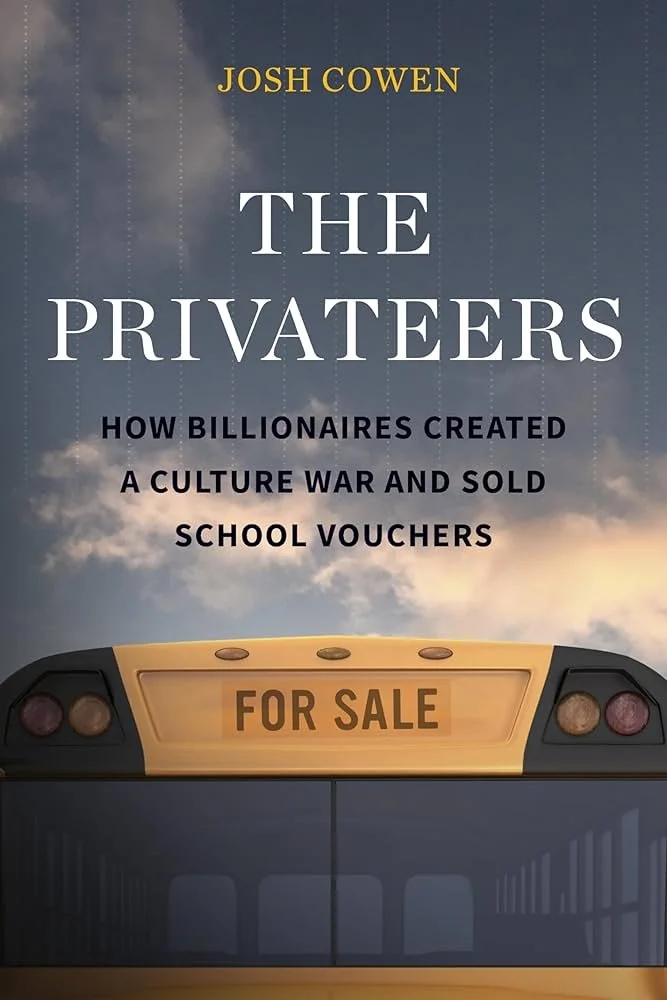
I have to admit that I struggled to read this book. I didn’t struggle because the material was boring or the author’s writing style was hard to grasp. I struggled for two reasons: 1.) The relationships between the people and the agencies discussed is complicated, to say the least; and 2.) The topic of the book- School Vouchers- made me so angry I could have chucked the book across the room, except I was reading on an iPad and that would have been expensive.
What are School Vouchers?
The term ‘School Voucher’ is one that has been floating around pretty often in recent years, so it may feel like it’s a new concept, but I promise it’s not. Before I explain where this concept originated, we need to have a common understanding of what a school voucher is. In it’s most basic form, a ‘school voucher’ is a gift certificate from the state government to the parents of a school-aged child (you get one for each school-aged child) to be used for the education of that child at the school of the parents’ choice. There are a few different names I’ve seen floating around for this type of program; names like ‘Empowerment Scholarship Account’ (Arizona’s program'), or ‘EdChoice’ (Ohio), or ‘Parental Choice Program’ (Wisconsin) are all currently in use. But, despite the name, the idea is the same.
On the surface this sounds like an amazing concept, right? You get to send your child to the school you think will give them the best education possible, on the government’s dime- or at least that’s what it sounds like. It sounds like it should solve all of our problems with education in this country, because suddenly only the ‘best’ schools will be in operation, right? Unfortunately, that is not how these programs end up working in reality. But, before we get into how the operation of these programs are actually working- and the consequences thereof- let’s take a look at some history.
The History Behind School Vouchers
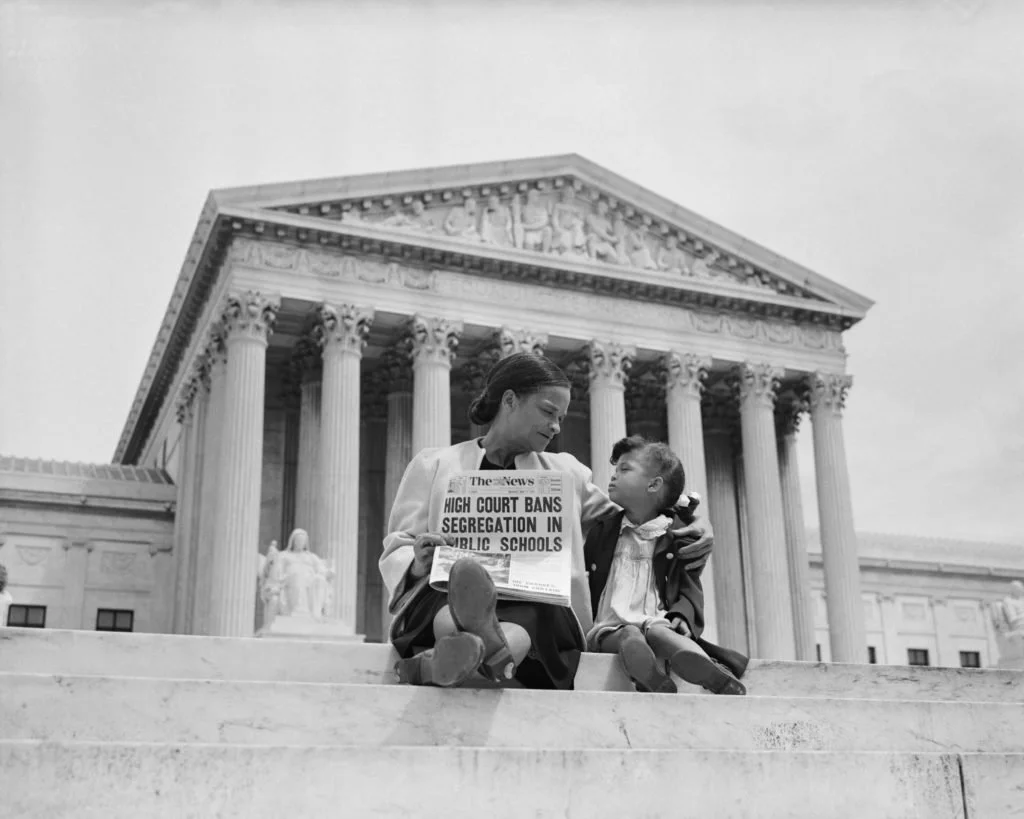
Courtesy of Getty Images via the Legal Defense Fund Website
On May 17th, 1954, the Supreme Court of the United States of America issued a ruling that would change education in America forever. Brown versus the Board of Education was a civil case brought by the NAACP on behalf of Linda Brown- a black student in Topeka, Kansas- and a few other students that argued the doctrine of ‘separate but equal’ was unconstitutional. The Supreme Court unanimously ruled that ‘separate but equal’ was indeed unconstitutional and that segregation must end, and that schools needed to integrate.
By now you’re probably wondering what in the world the end of segregation has to do with school vouchers, right? Well, the end of segregation was the inspiration for school vouchers. Milton Friedman- a Chicago-area Economist- first proposed the idea of school vouchers as a work-around for integration. The idea was that the state would issue an equal-amount voucher for each student to their family so that the parents could then choose which school to send their student to, whether it was private or public. Naturally the families of white students would choose to send their students to private schools who could set their own criteria for admission, and the families of black students could either send their students to the local public schools or form their own private schools. So much for integration, right? Luckily the idea didn’t catch on at this point.
President George W. Bush signed the bipartisan No Child Left Behind Act in 2002- federal legislation that required standardized testing, annual yearly progress, school accountability, and a number of other items. It also presented the opportunity for school vouchers to launch their comeback tour- this time under the premise of parents being able to send their kids to the schools with the best academic scores, rather than being locked into the public school they would normally attend. Again, this sounds like a great idea, right? You’d be able to choose the school- public or private- you think is best for your student(s), right? Not so much, because there is a whole lot that isn’t being said, and this is where Josh Cowan’s book The Privateers really kicks in to explain things.
The Reality of School Vouchers
Cowan’s book is extremely detailed and is heavily based on research- which is why it is a great resource!- but it does become difficult to read because of these things. However, it is apparent that there are two main reasons he does not support school voucher programs: 1.) The money behind the situation; and 2.) The academic results of the situation.
The Money Behind School Vouchers
This is, by far, the hardest and the most infuriating part to understand. The first thing to understand is that there is more money at play than just our tax dollars set aside to fund public education. There is a slew of nonprofit organizations, political action committees, think tanks, and institutions that are pouring money into the fight to pass school voucher legislation in every state in the union. A few of the major players include:
American Federation for Children: this group was co-founded by Betsy DeVos, President Trump’s Education Secretary during his first term. The group’s main mission is to advocate for the support of school vouchers.
EdChoice: formerly known as the Milton and Rose D. Friedman Foundation (the very man that came up with the idea of school vouchers), this group’s mission is to fundraise in order to finance school voucher research.
The Heritage Foundation: the very same right-wing think tank that brought us Project 2025.
The Walton Family Foundation: the foundation funded by the Walton Family- the owners of Walmart- who have provided scholarship funds to make it possible for school voucher research to take place.
That list is definitely not definitive, believe me. And, as you’ve noticed there are some familiar names on this list. So, why are they pouring millions of dollars into research, support, and propaganda? Well, there are the reasons that they publicly share, such as:
Parents should have the ability to choose which school their child(ren) attend, no matter their income
Students deserve to attend successful schools, where they can become high achievers
Education is a consumer good, and therefore is something that should be paid for by parents, and not tax payers
And then there’s the unspoken reason: there is a profound amount of money to be made from the privatization of education in the United States. Beyond this, Cowan doesn’t go into much more on the financial aspect of public school vouchers. However, he as a great deal more to say about the academic results of those research studies these institutions pay for.
The Lack of Academic Advantages of School Vouchers
One of the things that I remember learning during my public school education was the Scientific Method. My teachers explained that this method worked, no matter what hypothesis was being tested, or which branch of science it was in. They also made sure to point out that it was the method used by professional scientists worldwide to conduct all kinds of research. Imagine my surprise when Mr. Cowan demonstrated that the main researchers into the effectiveness of school vouchers on students’ educational outcomes were playing fast and loose with these rules (please note that this was said with sarcasm).
While reading about the structures of several of the studies described in the book, one of the first things that I noticed is that the researchers left too many variabilities in play when designing each study. In one study alone, each school was allowed to choose its own standardized test to evaluate the students in the voucher program, meaning that test results could not be directly compared. Additionally, the schools did not administer the tests at the same point in the school year, and they also had the ability to select which students participated in the standardized testing for the research project. The researchers also left themselves vulnerable to the schools self-reporting the testing results. You don’t have to look very hard to see how contaminated the results of the study were. Then, when the results were published, the propagandists- of course- cherry-picked the information even further to support the conclusions that the investors (i.e. the American Federation for Children and EdChoice) wanted.
Despite the contamination of the research due to significant holes in the structure, the research into the effectiveness of school vouchers- when taken as a whole- is consistent across the board: they simply don’t work. In Wisconsin, students were found to excel in school- to begin with- but over the long term, they actually performed worse academically than their peers at both their original school and their new school. The initial surge in growth is thought to be the result of ‘catching up’ academically. Additionally, nearly every student who received a voucher chose to return to their public school by the end of the third year, where they began to accelerate academically. In another study, students were only allowed to participate in the voucher program if they were entering Kindergarten for the first time, AND their parents had predetermined to put them in a private school (this makes no sense to me; why would you only study children who’ve never been to school, especially ones whose parents could already afford private school?!). Still, even these children demonstrated that they were no better off academically than their public school peers.
Conclusion (At Last!!)
I get it. The concept of school vouchers sounds incredible! Who wouldn’t want the opportunity to give their child(ren) a better education?! But, after the glitter has fallen off, and the shine has been wiped away, school vouchers are nothing more than another way to degrade public education and- this time- to segregate students based upon their family’s net value rather than their skin color. But, that’s a discussion for another blog post.
Works Cited
Cowen, Josh. The Privateers: How Billionaires Created a Culture War and Sold School Vouchers. Harvard Education Press, 2024.
NAACP Legal Defense and Educational Fund. "Brown v. Board of Education: The Case That Changed America." NAACP Legal Defense Fund, www.naacpldf.org/brown-vs-board/. Accessed 20 June 2026.
Wolanin, Thomas R. "A Past, Present, and Future Look at No Child Left Behind." Human Rights Magazine, American Bar Association, www.americanbar.org/groups/crsj/resources/human-rights/archive/past-present-future-look-no-child-left-behind/. Accessed 20 June 2026.