
The Essential School Board Book: Better Governance in the Age of Accountability
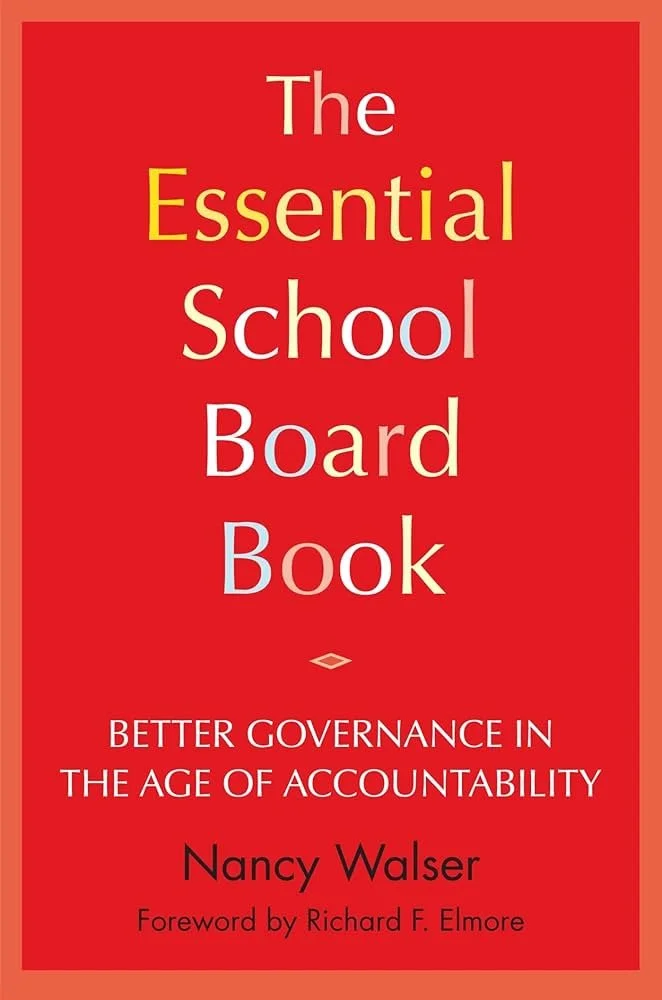
When I asked my mentor what types of books they suggested I add to my reading list in order to prepare for this role, they suggested I include some books on governance, so I found a few (12, to be exact… 😊).
This was one of the first books that came up when I did a Google search for books on the topic of school board governance. Although this gem is only 6 chapters, it explains something at the very core of how the Los Lunas School Board governs: policy governance.
Policy governance is the operating system that shapes how our school board guides and directs our school district. It sounds really fancy, and maybe even hard to understand, but at its most basic level, policy governance is the process of creating goals and guiding rules based on federal, state, and local laws, as well as desired outcomes that tell the superintendent what they are and are not allowed to do to achieve the goals.
Let’s see how this works in real life: right now the Los Lunas School Board is working to develop it’s 5-Year Strategic Plan (I’ll have more on this in a different blog post). This plan sets forth all sorts of goals for our school district; there are goals about student achievement, staff development, and community involvement. These goals are filtered through a whole mess of federal, state, and local laws, as well as the wants and desires expressed by our community. Now, this strategic plan is still in the development phase, but when it’s completed, it will be voted on by the school board and will become policy- or rather a document that outlines the goals and desires of the school district and what the superintendent is- and is not- allowed to do to achieve those things. Then, the superintendent provides systematic updates on how the school district is working to follow the strategic plan and achieve those goals and desires.
BUT- and here’s the caveat- this form of governance only works when the school board shares a mutual understanding that they are there to serve and support the education of students in the school district. It only takes one or two individual board members to stall the progress of policy making, and policy governance. Through many different interviews with school board members across the country, the author concludes that it is usually the individual school board members who report for duty with their own personal agendas to enact that slows down- or even stops- the progress of the entire board. Such school board members are often found to be pursuing personal vendettas, or are looking to micromanage different aspects of the school district’s operation. To prevent this, many boards have developed their own governance policies that help to keep the board on track and focused on what matters most- the students they serve.
After reading this book, I feel like I have a deeper understanding of the mechanics of how the Los Lunas School Board works to guide and serve our school district. I still have a great deal left to learn- which is why I have 11 additional books on this topic- but I feel like I now have my footing under me in order to begin to understand the finer points of this system.
I did purchase my copy- it’s available on ThriftBooks, as well as Amazon. I’d offer to lend my copy out, but this time my notes are in the margins and not in a separate notebook.
Works Cited
Walser, Nancy. The Essential School Board Book: Better Governance in the Age of Accountability. Rowman & Littlefield, 2014.