
The Death and Life of the Great American School System
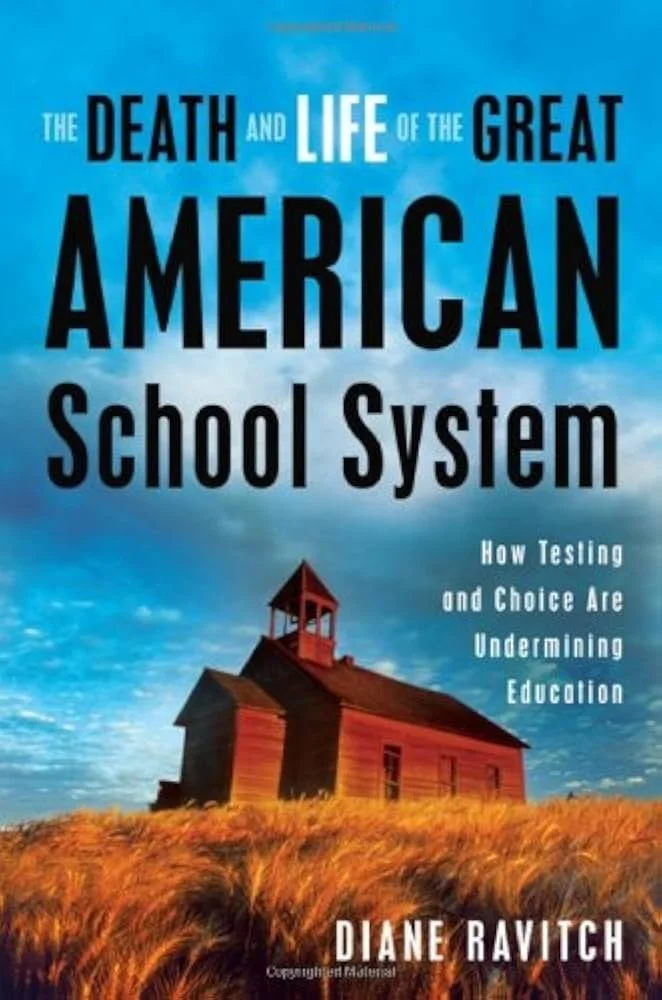
My family likes to tease me endlessly because one of the first things I do when I take on a new job or project is look for a book, because I want to learn as much as possible before I begin. Very often, I end up with a list of books that I do end up reading in relation to the job or project. So, when I set out to run for the school board, this was one of the first things I did, and The Death and Life of the Great American School System by Diane Ravitch is one of the first books I found.
One of the things that I look for in non-fiction books of this nature is what qualifies the author to have written the book. What experience do they have to speak authoritatively on the subject? Well, Ms. Ravitch served as the Assistant Secretary of Education under President George Bush, and was instrumental in writing the legislation that eventually became the No Child Left Behind Act (NCLB, for short). This experience lends credibility to her authority in writing this book.
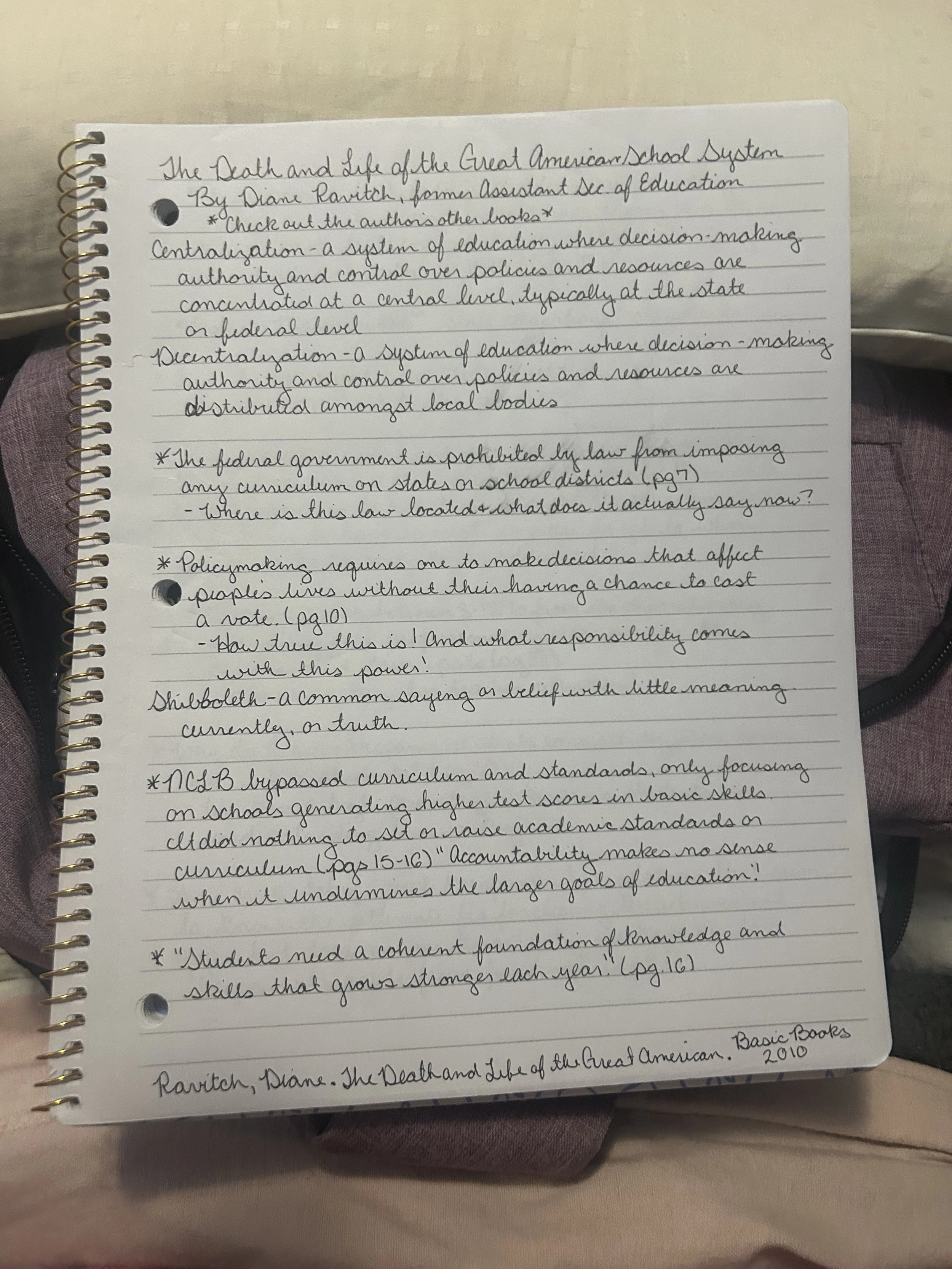
When I do this kind of reading, I’ve developed my own system for annotating these books. I write down quotes with page references, as well as my own thoughts and questions while reading so that when I write reviews like this, or need to include it in research for any given reason, I have my own personal written summary to refer back to.
The two main topics Ms. Ravitch tackles in this book are the way that standardized testing under the NCLB has caused a huge shift in the education of students, and why
the public school voucher system is not the saving grace it first appears to be.
Until reading this book, I hadn’t realized that the NCLB allows states get to choose the test they use, and they get to set the benchmarks for proficiency standards, without any nationwide guidance. This made me realize that when we’re comparing our state’s standardized test scores against every other state in the nation, we’re in fact comparing apples to oranges to pears because each state has a different test, with different set standards. Because of this, I plan to research the specifics for our state: what test(s) we’re using, why we’re using them, how they work, and what they measure, as well as the proficiency standards our state has set in place, why they’re set at what they are, and how they get set to begin with (y’all can expect a future post on this!).
Like many of you probably have, I’ve also heard the rumblings about school vouchers, and the idea that we could receive money from the government to send our child(ren) to any school of our choosing- including private schools, parochial schools, charter schools, other public schools, or possibly even purchase homeschooling materials. But, after reading this book and learning where the idea of school vouchers originated and reading about how they’re working out in practice in the Milwaukee,
Wisconsin school district, it became clear to me that this is not the solution it first appears to be. First, I would argue that although Milton Friedman (the man who first suggested the idea of school vouchers) did not intentionally intend for this solution to be weaponized in the way that it has been, the school voucher system has become a way to further propagate and promote segregation because it allows those families with wealth to afford even more elite private schools who set their own admissions criterion, while also draining funding from local public schools, where students whose families have no other choice attend school. Secondly, what the school voucher system does is turn education into a for-profit business. When this system was introduced into the Milwaukee School District, a host of unaccredited schools popped up with promises of smaller classes, more prestigious instruction, and better results (i.e. higher test scores). In reality, many of these ‘schools’ were found to be located in vacant shopping malls, with little to no supplies and bare minimum staffing. Essentially they were created as a cash-grab for the owner of the school, and it was found that when these students eventually transferred back to their local public school, they were further behind than their peers.
While Ms. Ravitch covers other topics throughout the book, such as the role of modern school boards under NCLB, these were my main takeaways, and have given me additional reading material, things to research, and a more structured direction for my preparation to become a School Board Representative for District 1.
Oh! And if you’d like to read this book for yourself, the Los Lunas Public Library has a copy! I borrowed it to read!
Works Cited
Ravitch, Diane. The Death and Life of the Great American School System: How Testing and Choice Are Undermining Education. Basic Books, 2010.